An Indie Developer's Rantings

Friday, May 4, 2012

Game Challenge - An Introduction

I have started a new channel on Youtube called "Don't Start" to hold all the videos for the David Perry Challenge. I have also posted the first video, outlining my goals for the challenge.


As it stands, I will playing games on the following systems:

  • PC: 20 games
  • XBox 360: 20 games
  • PS2: 20 games
  • NES: 10 games
  • SNES: 10 games
  • Gameboy: 10 games
  • HP Touchpad: 10 games
I already have the list of games I want to play set, though I will not be revealing this list beforehand in case of any of it has to change for whatever reason.

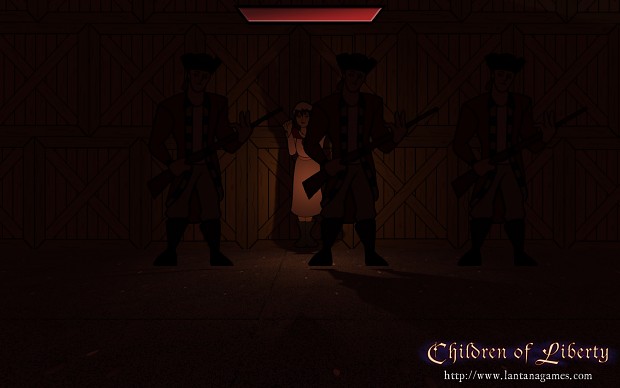
Now, the tricky part. I am poor. Quite poor. Sentence fragment. In fact, I straight up can not afford to do this challenge, and I want to do it right. As I work in the game industry, I have not ever nor will I ever pirate games (Abandonware is another matter altogether, and I love Abandonia.com). I am wondering, since this is basically a combination of a thesis and a bit of a creative endeavor with the Youtube channel, if a Kickstarter would be a smart way to go to help me do this challenge right (I would need probably close to $1500, more if I expand the channel to include other kinds of videos). My other alternative would be to source games from the community and my friends, to see if anyone would be willing to let me have some of their old cartridges. However, I do have games in the list that are a download-only affair (like the ones for the Touchpad) so those will still eat into my available funds. Thankfully I have two years to get this all done, so hopefully by that point Children of Liberty will have sold a few more copies (won't you please help a starving indie out?).

I'd like to do some other stuff with this channel too. Podcasts, Let's Plays, News, maybe even bring in some other content creators so I still have time to work on Children of Liberty. Additional content depends on if other people want to contribute videos and if my development time permits me to be doing anything else. If this starts interfering with my development time I will have to put the challenge on hold, but with my current goals I should be able to do it.

Please make sure to Subscribe to the new channel as the first of my 100 games will be up some time next week(ish), and one a week from that point on!

Thursday, May 3, 2012

David Perry's Game Design Challenge

Over the last several days, I have found myself utterly bored by my current game collection. Nothing has really sparked with me, I've had no desire to load up anything too in-depth or too frantic, so I find myself playing The Binding of Isaac over and over and over again, to the point where I have added another 20 hours of playtime to it and have only beaten it one more time (ugh). It's time for a change.

Enter David Perry from Gaikai, who has challenged students to play the Top 100 games on their platform of choice as listed as Gamerankings.com. For me, this would be the PC, however if I can manage it I would also like to throw in some NES/SNES, Gameboy, XBox 360, and PS2, so howabout the Top 20 games from each? I most likely have experience with a good 50% of this list anyway, but that's good because I don't have the money to buy all of these games. However, I have the money to buy a few, and my goal is not to play one a day but one a week. I will then make a video a week (yes, a VIDEO dammit, my own, more intellectual version of a Let's Play) detailing what makes each game fun, what design/graphical tricks are used, and what design patterns stand out to create the core experience of the game.

Over the weekend I'll be loading up on full games/demos for PC, as well as trolling around ebay for some classics for my NES/SNES hybrid machine, my old, dusty Gameboy Pocket, my underused PS2, and my 360 aka "The Netflix Machine."

Long story short, Mr. Perry, I may not be a student but I accept your challenge anyway!

Thursday, March 1, 2012

The Takedown Tribunal: PAX East Stealth Games Panel

I'm probably in here somewhere, unless I was eating lunch.
I seriously cannot wait for PAX East. Besides being the first convention where I will be an exhibitor, I am also on my first panel! The panel's name is "The Takedown Tribunal: Three Indies Talk About Their Upcoming Stealth Games." Join myself, Andy Schatz of Pocketwatch Games, and Nels Anderson of Klei Entertainment as we discuss Children of Liberty, Monaco, Mark of the Ninja, and what makes stealth games great! Here's the panel description:
The Takedown Tribunal: Three Indies Talk About Their Upcoming Stealth Games
Cat Theatre
Friday 9:00pm - 10:00pm
Do you love lurking in shadows, stabbing guards in the back and/or stealing the stuff they're supposed to be protecting? We do! Stealth games have a vocal and passionate following, but among developers, they're notoriously difficult games to create. Even experienced AAA studios with hundreds of developers and multi-million dollar budgets will avoid stealth games in favor of more clear-cut genres. However, at least three small independent developers have thrown caution (and their sanity!) to the wind and set out to not only make stealth games, but rather non-traditional stealth games. So now we want to discuss the genre we love with an audience passionate, or simply curious, about these new takes on stealth. Andy Schatz's IGF award-winning Monaco demonstrates through 4-player coop just how well a heist can go with a good plan and how much can go wrong with a bad one. Klei Entertainment's Mark of the Ninja takes stealth action into 2D with style, flair and blood (and ninjas). Boston locals Lantana Games' upcoming 2.5D platformer Children of Liberty takes an historical approach to stealth, detailing the story of four young spies in the events leading up to the American Revolution. Matthew Weise, MIT's GAMBIT Game Lab's Game Design Director and the creator/host of a podcast documenting the history of Looking Glass Studios (creators of Thief, one of the most important games in the stealth genre), will moderate.
Panelists include: Nels Anderson [Game Designer, Klei Entertainment], Andy Schatz [CEO, Pocketwatch Games], Dan Silvers [Resident Game Designer, Lantana Games], Matthew Weise [Game Design Director, Singapore-MIT GAMBIT Game Lab]
Remember, the panel will be on Friday, April 6th at 9pm in the Cat Theatre. Hope to see you there!

Also be sure to stop by Indie Alley to play the latest build of Children of Liberty. With any luck (and a lot of crunching over the next month) all four characters will be playable!

Monday, February 20, 2012

Lay Off the Layoffs

There is a culture which permeates all game development, both AAA and Indie: the culture of the Launch Layoff. You know how it goes. Your game launches one day, the next day you're out of a job. This has been happening for years, and it's time for it to stop.

It used to be that we would see a powerhouse indie studio rise up from the ashes of a fallen AAA studio, but the days of "for every one of us who falls, two more will take our place" are fading. Yes, there are a lot of indie studios still, but it seems many people have become complacent in the cycle of Get Job -> Make Game -> Lose Job.

This is not the fault of the employees. It is the fault of the entire industry for making us believe that Layoff Culture is and needs to be the norm. There are a few key steps that companies could take to prevent this from happening. Whether or not they will is up to them.

  1. Smaller Games: Not every game needs to be Skyrim or Grand Theft Auto. Games are getting huge, so huge they're almost worth more than the current $60 price tag, and raising their prices will be the only way to keep producing games of this caliber. Developers need to be willing to work on smaller projects, much like indies do, that can make their money back at more reasonable prices or, if remaining at $60, will be successful enough to allow the hardworking team to keep their jobs.
  2. Smaller Teams: The days of skeleton crews for Pre and Post Production need to be over. A team of 100+ employees is too big, and obviously (for a powerhouse studio) 5 people is too small. Keep it reasonable, 10-20 people. Contract out whatever work you can and keep your overheard low. Aim to come in under budget so your team can keep their jobs when the game's done!
  3. Begin Preproduction Earlier: It's true that there are some jobs that aren't needed in the preproduction phase, and it's easiest just to layoff the current modelers, sound designers, etc. when your company enters the preproduction phase and hire new ones on when the game's been greenlit by the publisher. My solution: begin preproduction of the next project earlier so that the post-production of one game and major production of the next begin at the same time. Yes, this is expensive, especially for big teams, and for small teams the focus needs to be on the current project. Small teams, however, have no need to just sit around and lollygag in a preproduction phase. So, this brings me to my next suggestion:
  4. Eliminate Preproduction Entirely: Very few forms of art have a "preproduction phase." The only two I can think of are movies and games. Movies need them because they need their sets scouted and/or built beforehand, they need to find their cast, they need the script written, etc. Games are much more iterative and can be built in real-time. Concept artists, animators, and modelers can work simultaneously to have a character designed and brought to life in a matter of hours instead of weeks if working separately. AGILE techniques can be used to bring a game to life in realtime instead spending months writing up a design doc that details every little bit of production, only to have that doc get trashed down the line because it can't keep up with what's actually happening in the game's development. Games don't need a huge preproduction phase, they need a quick and dirty proof of concept, a prototype that shows core gameplay, and that's it. The less time spent in preproduction, the more money a studio has to come up with new ideas for potential publisher pitches.
  5. Publishers Need to Take Risks: The only reason new IPs are tough to come by is because publishers want sequels. Franchises mean money thanks to name recognition. Give developers the chance to stretch and experiment after a game's launch and there will be many great surprises in the video game industry. This, however, also means publishers need to greenlight potential flops, and that is okay. It's not a venture if it's not a risk, and the best way to learn - for publishers, developers, and everyone else - is to fail.
  6. Crowdsource Your Idea: If you're not under publisher control, there's no reason to wait for publisher money anymore. I've talked in-depth about how the publisher model is not dead, and also how not all Kickstarter games will be successful, but while it's still a viable option there should be nothing stopping your team from saying, "Are the people interested in this game?" and actually asking them that very question. Why predict when you can survey, and why just get a bunch of "Yes" answers when you can get actual dollars? Don't think that Kickstarter is the only option either. If you run a company with a well-recognized name and plenty of media coverage, you can crowdsource your games on your own website.
What this all comes down to is NO MORE SITTING AROUND! You want to make games for a living? Make games and don't STOP making games! The money thing will take care of itself in time. Take a page from the indie playbook and just dive right in.

Friday, February 10, 2012

The Publisher Model Is (Sadly) Not Dead

First of all, I would like to start this post my congratulating my friends at Double Fine on DECIMATING their Kickstarter goal in less than a day. Way to go guys!
ROCK THE FUCK ON, DOUBLE FINE!
For those unaware, Double Fine have raised over $1.3 million in just over a day on Kickstarter. This is record shattering, especially considering they were only looking for $400k to make a game by Rocktober. Based on this and a few other outliers, many now believe that the traditional publisher model is dead.

Oh how they couldn't be more wrong.
Still alive!
If developers begin relying solely on crowd-funded sources for game development, we haven't gone anywhere in terms of progressing the power over what games we're "allowed" to make. Let me explain. Right now, the process goes something like this. You prototype a game, you show that prototype to a publisher, they shoot you down, and you go back to the drawing board; or they LOVE your game and give a bajillion dollars. With crowdfunding, just replace "a publisher" with "the internet." Considering the number of trolls and "TL;DR" types on the internet, it's not exactly an ideal place for business pitches.

Don't get me wrong, I love Kickstarter. I ran one myself almost a year ago to fund Children of Liberty, and it was successful, making $5944 out of a $5000 goal, or 118% of what we wanted (minus the Kickstarter and Amazon fee). However, a full commercial game cannot be made on $5000 alone, and we knew it, but thank GOD we didn't ask for more. I've never gone into this before, but I'd like to show off some of the metrics from our Kickstarter, if you don't mind bearing with me for a bit.
This graph shows what our funding was over the course of the 60 day period during which we ran our Kickstarter, from March 10, 2011 to May 10, 2011. The first 48 hours were immense and we made just over 50% of our goal (thanks, families!). However, after PAX East, it tapered off. Over the next 6 weeks, we made just over $1000. That's $166.67 a week, not even McDonalds money.

(The saddest part of this is that this tapering period also included our extremely unsuccessful grassroots campaign around Boston to find backers, which you can read about at Boston Indies).

A question many people have asked me is, "Why didn't you shoot for more?" Three reasons: one, this was our first Kickstarter AND our first commercial game, so naturally we needed to play it a bit on the safe side or we'd make $0; two, we'd had zero coverage on the game up to this point, so no one had heard of it or us; and three, we had a very specific use for the $5k we wanted off of Kickstarter: Unity Pro. We knew the game was going to need to be heavily focused on the use of shadows both aesthetically and mechanically, so Unity Free was not an option.

One thing to keep in mind is that at the time we ran our campaign, Kickstarters were not considered news. Kotaku had not yet started their weekly Kickstarter-based column to help indies out. Few people retweeted or shared the link who were not close friends or family of ours. By the end we made our goal, but it was cut close - too close. We hit our goal on May 3, one week before the end of the campaign. This was also the around the time Kickstarter decided to feature us on every page imaginable on their site that would help us out: Project of the Day, Video Games, and Boston at the same time. You couldn't browse around the site without finding us! However, we still made under $2000 from direct traffic on Kickstarter itself. Most of our traffic was still coming from our Facebook and Twitter, so thank you so much to the gracious fans of Lantana Games!
And damn if it ain't lookin' pretty now.
Luckily for those running a Kickstarter in 2012, things have drastically changed. News sources are now TOTALLY WILLING to cover Kickstarters, just make sure your game is cool. The other thing that's changed is now, thanks to Double Fine, people are willing to shell out a lot more money a LOT more quickly to the most awesome of ideas.

This brings me back to my original point though: the traditional publisher model is not dead, not while there is one Double Fine Adventure Game to every 100 Children of Liberties. $5000 is not our entire budget, and if it was we most certainly would not have moved into Unity Pro; or been able to bring on our awesome animators Mike, Ricky, and sound guy Rob, all of whom are giving the game an incredible atmosphere.

Indie developers still need publishers, not necessarily for funding the game's development, but definitely for everything else: PR, distribution, localization, etc. All of these things cost a LOT of money, money that is certainly out of range for most indies. Many indies see all publishers as intrinsically evil though. There is this stigma that if you have EA backing you in some way that you're no longer "indie." Well guess what guys? EA  Partners distributes Shank, a very indie game and a personal favorite (oh and buy Shank 2 on Steam now!). Can the average indie afford $100,000 in development costs, $20,000 in localization costs, $50,000 in PR, and more money for console testing, legal fees, and everything else on their own? Hell no. Can they get there with a Kickstarter? I'm going to have to be a pessimist here and also say no. Maybe you'll get your full development costs off of Kickstarter, but don't bank on getting enough for the rest. I've never revealed Children of Liberty's full budget, and I won't until it's done, because even though it's more than what we got off of Kickstarter, it's still head-scratchingly low.
This shit's rarer than oil.
If anything, there is now room in the ecosystem for indie publishers, companies willing to shell out for PR, distribution, and localization of independently developed games while only asking for 10%-15% on royalties; companies who would be willing to help new developers get their games tested and out the door onto services like Steam, Desura, and included in The Humble Indie Bundle and IndieRoyale; who then take all the money they've made off of one indie project and use it to help fund the next indie project. Is that too much to ask for?

Kickstarter is awesome, but it is not the new mold. Double Fine is an outlier, a shining example of what to aim for, much like Minecraft's sales numbers. Keep in mind, though, we cannot all be Tim Schafer or Marcus Persson. Some of us are still going to get laughed at when we hand out postcards with our Kickstarter info on it, only to scrape up a few measly bucks from the bowels of the world wide web, sometimes not coming anywhere close to our intended goal. Some of us will give up because, hey, we gotta eat, and others will trudge forward until the game's done. Either way, guess what? The model's the same. Kickstarter or publisher, you're putting the future of your game in someone else's hands.

Tuesday, January 24, 2012

Final Form Bosses


We've all seen them, and we all hate them. You've been playing a game for ages and have been introduced to an antagonist whom you can't wait to beat, only to discover that while it IS the last boss of the game... it's not quite what you were expecting.

That's right, they made the boss bigger in a cheap attempt to intimidate the player. If this isn't the game mechanic version of a Deus Ex Machina, I don't know what is. Think about it. Throughout the game, you've accumulated vast amounts of power, even more than what you've seen from the main villain. So what is the developer to do in order to make the boss challenging? "I know, let's inexplicably make them 10 times bigger and more powerful! Oh, and while we're at it, make them look NOTHING like the main villain we've seen all game."

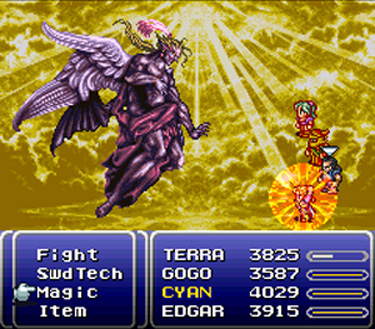
The concept of the Final Form Boss, as I will refer to it, can be traced back to the SNES days. Back then, while it was normal to have all character sprites be of the same size, enemy sprites would often be bigger, especially in JRPGs. Enemies in such games were more likely to be unanimated but highly detailed paintings. Of course, final bosses couldn't be the same size as the player in combat, even if we'd seen them at that size for the entire game, and thus their in-battle designs would show only modicum of similarity to their more common form.

As technology has improved, however, the Final Form Bosses have not gone away. In fact, they remain as prevalent as ever, and I must ask... why? Is it so much to ask that we pick on someone our own size?


The need for Final Form Bosses is almost inexcusable now. As I mentioned, the need originally came from the fact that basic enemies were just highly detailed but unanimated sprites. Now we can have it both ways: detailed AND animated. It's the best of both worlds, and yet what do we see time and time again? Giant god damn Final Form Bosses.

Things are starting to get a little bit better, though. Batman: Arkham City has a fight against a regular-sized Joker. The bosses in Deus Ex: Human Revolution are proportionate to Adam Jensen. The Assassin's Creed series hasn't jumped the shark quite enough to throw a 6-story Templar your way. There is some hope in this area, but not a lot. No matter what, though, bosses still have one major problem: patterns.

Developers still feel the need to give bosses attack patterns so they can be more easily defeated. When this is against a Final Form Boss, you feel empowered, like you've accomplished something. When you do this against a boss who is around your height, weight, and polycount, you feel... ripped off, like you were almost expecting another player to be controlling that boss; someone who can think like a human instead of a gigantic machine.

It is a strange discrepancy. We can forgive Final Form Bosses for being big and dumb because they're too big to be anything other than pattern-based. Get a boss around our size, however, and they still act big and dumb because the programmers only have so much time on their hands. What's a designer to do?

Well, for one, size can indeed equal intimidation, but if you want a big final boss then give us a big enemy to begin with. Making them suddenly go "I'M BIG NOW!" is a lame device meant to scare away lesser players and, let's face it, it's 2012. We're all smarter than that now.

Yet video games will always have the stigma of the Final Form Boss attached to them. We expect the biggest monster of them all to come at us at the end of the game, to test our mettle, and use every last bullet we've got to take them down (or some cheap, introduced-at-the-last-second uber weapon that is only used to defeat them). To that, I say nay. Though I do wish to test my mettle, I do not wish to do so at the cost of fighting a form of the main antagonist I wasn't promised. Monster Mega Smith? Please. Mecha Hitler? For fuck's sake. Let me fight with whom I was promised a fight or I want my $60 back.

Friday, January 13, 2012

Let's Just Settle This Already

Guess what folks? This is a post about breasts. But it is also a post about robot penises.

You know Adam's smoking that cigarette for a reason.
In short, this is a post about how I am fed up with everybody in the media criticizing game developers for how they design their characters.

I just finished reading an article over at IGN on the debate about the size of Bioshock Infinite's Elizabeth's breasts and the merits of the game's story, as if one has anything to do with the other. Each paragraph in the article can be summed up by alternating between "Ken Levine is a genius" and "Ken Levine is an asshole for giving Elizabeth breasts."

First, let me clear up the confusion on the personnel involved. Ken Levine did not give Elizabeth big breasts. The talented concept artists, modelers, and animators at Irrational Games gave Elizabeth big breasts. Okay? Okay! Ken Levine is not the entire company.

Caption 1: Ken Levine is not JP.
Caption 2: JP wanted a robot penis WAY before Adam Jensen got his.
Now let's talk about this article directly. While the author, Colin Campbell, claims to not be the biggest feminist on the planet, the article itself absolutely caters to the lowest common denominator of feminist readers by hitting all the necessary bullet-points:

  • The artist is not to blame
  • But yet the artist IS to blame
  • Why does this character need big breasts in the first place?
  • Lara Croft
Let's face the facts here. This is a VERY diverse planet and each person is a snowflake. No two people look 100% alike, thanks a little thing called genetics. The same thing goes for video game characters, thanks to a little thing called copyright infringement. No woman in real life wants to be generalized because of the size of her breasts, so why do we feel it is okay to generalize fictional women for the same reason?

The criticism leveled against game developers over the last couple of years for their choices regarding bust size, I feel, goes against every feminist sensibility ever laid out. If we were to judge real women for their breast size in real life the same way we feel comfortable judging female game characters, every single online so-called "journalist" would have been fired for sexual harassment. Last I read, looking at breasts actually strengthens human hearts. So why all the bosom hate?
No, not these breasts, but these are also high in protein and therefore good for you as well!
The size of a character's breasts should have no bearing on their being a positive or a negative role model, and yet it does. "The bigger the breasts, the bigger the slut," is the attitude I keep seeing regarding female characters in video games. Alyx Vance is a character I often see referred to as a "positive female character," yet I'd hardly call her flat-chested. Jade from Beyond Good and Evil is another, yet her midriff is prominent. Since these are the only two characters who I commonly see referred to as positive, let's take a look at some characters who have been criticized for their figure, yet should be judged by the quality of their character:
  • Lara Croft has made countless archaeological discoveries, contributed to the scientific community, is a philanthropist, is completely self-reliant, and has fought DINOSAURS for crying out loud.
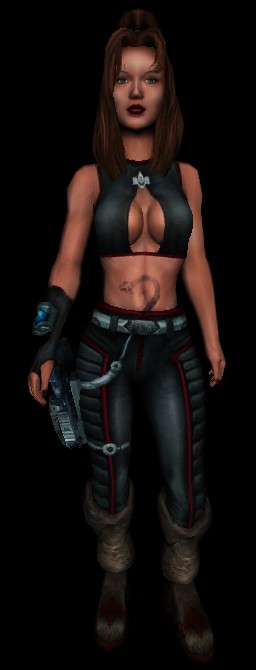
  • Aida in Unreal 2 was highly intelligent, an ex-marine, willing to make extreme sacrifices, and was a hell of a pilot.
  • Femshep was immediately criticized because she was blonde. What the fuck is wrong with you assholes? Shepherd has stopped Rogue Spectres and Collectors, a couple of Reavers, SAVED HUMANITY, and you're going to judge the first public female portrayal of this character based on her HAIR COLOR?! How is BLONDE a negative portrayal of women? Someone tell me this, please.
If you want to talk about sexism in the portrayal of women in videogames, look no farther than your own mirror. None of this is the fault of artists. Do they create idealized figures? Sure, but this is something artists have been doing since the Renaissance. If you really want to push the discussion on female characters along, get over their bodies already. What do you care what they look like and what they wear anyway? Real or fiction, a person's actions should speak louder than their looks.

Here is my parting thought: a soldier returns home from war. This soldier saved five squadmates in a 3-day firefight, hold up in a tower with nothing but a sniper rifle and barely enough rations. Calls for evac were ignored for days because the zone they were in was too hot. Finally, thanks to the efforts of this one soldier, SHE and her injured squadmates were able to be rescued via helicopter extraction. She returns home to her loving friends and family. She also happens to be a smokin' hot blonde with D-Cup breasts. Do you find that last part offensive? And if you do, my only question is... why?