An Indie Developer's Rantings

Sunday, June 24, 2012

Stealth Jam, Days 1 + 2: Creating Moonlight

I'm no stranger to Game Jams. I'm a huge fan of them as they allow me to practice my programming chops, not something I get to do very often these days. As I am also a developer of a stealth game, when I heard a Stealth Jam was coming up, I couldn't wait for the opportunity to make something COMPLETELY different from Children of Liberty. As much as I love the kids, they really have been eating me alive the last three years and it feels great to make something fresh.
Epic title screen, inspired by Apogee's Hocus Pocus.
Thus, I am creating a game entitled Moonlight: Mistress of Mischief. I decided to look back to my shareware days for inspiration, to a game called Crusher by William Soleau. The goal of that game was to collect bits and pieces of treasure scattered around a randomly generated castle, while crushing monsters via blocks you could push. You had a limited resource for survival, Oxygen, and if that ran out it was game over. There was also dynamite you could pick up should you need to explode a block in your way.

This game gave my mom nightmares.
Immediately upon starting Moonlight, I knew I had to do away with the resource for survival. As this is a stealth game, the goal should not be on frantically searching for a tank of oxygen (or in the sequel's case, a candle). No, the goal of Moonlight is to clear each room of treasure to the best of your ability.

I am yet to get Moonlight's sprite done, so for now she is a smiley face.
There are three kinds of jewels, Small, Medium, and Large, which are worth 1, 10, and 100 points respectively. The only enemy type so far is a turret which shoots in 1 of 4 directions, but can only see you if you move within two tiles of it. You can also hide in crates and move around (they even shake a bit when you step inside them!). Turrets will not shoot you while you are in a crate, and crates can even be used to block turrets completely or obstruct an enemy's view. This is probably the closest Moonlight will get to Crusher's original crush-to-kill mechanic. However, you cannot pick up treasure while you are hidden in a crate, so it's not like you can just run around willy-nilly and get all the treasure with little effort. There are also traps which hold crates in place should you run into one while skulking around.


The Red Key and the Blue Key make a triumphant return, along with their new friend the Yellow Key. All you need to do to open doors is step on a key, and all doors of that color open at the same time. This allows me to do many things in terms of a level's design. One, I can control the flow of up to 4 or 5 separate areas, which is a lot in a 608x480 space (640 pixels -32 for the UI on the left). Two, I can create gated puzzles which, though optional, can really test the player's stealthy skillset. Finally, I can lock off the exit, meaning that the goal of each level, and in fact the only way to progress, is to find the correct colored key which leads out of the current room. There are also gray doors I have added in as extra details to show blocked off passageways. Originally, I had wanted to make the game free-roaming like Crusher, but went with a linear game instead.
The first level has no danger, but instead teaches the player to appreciate treasure and how keys work.
Right now, treasure collection is the most important part of the game. After all, who doesn't love collecting treasure?! Before the Stealth Jam is through, though, I'd like to add a few more things, and change a few others.
  1. Moonlight really needs a sprite. I'll do my best to do her justice.
  2. I'll be returning the scoring system to number-based instead of bar-based. I had thought it would be neat to watch a bar fill up as you collected treasure, but there's a real disconnect with your progress. It'll look better to have the actual amount of treasure you've collected displayed prominently top-center.
  3. Moving enemies. The turrets are fine and all but their use is limited, especially in terms of level design. Getting some real enemies in there who can at least move back and forth and shoot at you when they see you will be key to making this game awesome and truly stealthy. On that same note:
  4. Takedowns. If you can get up behind an enemy, you should be able to stab them and kill then. Similarly, I may also put in Crate Takedowns, which would hold the crate where it is like its been trapped but with the bonus of you having just taken out an enemy!
  5. Nicer looking life icons, maybe just Moonlight's face with an X3, X2, or X1 next to it to save space on the side for an eventual inventory.
  6. Sounds. I love SFXR. If you've never heard of it, you should check it out!
  7. MUSIC?!
  8. MORE LEVELS! Mainly because I've made them really easy to make so I can crank out 1 or 2 more by 5:00pm tomorrow.
  9. Scoring system. This could be neat, based on how many gems you collected out of the total in the level and in how much time. However, considering how much more I need to get done, I may put this off for a future update.
  10. Decide on a platform. As of right now, the game is a basic Windows executable. However, because of its simplicity, I could easily see this working on mobile, in Flash, in XNA... Multimedia Fusion has so many exporters now my choices are pretty much endless. I'll leave it as a Windows game for now but with the plan of porting it everywhere when it's done.
  11. So much more I want to do. Items, different enemy types, different environments with modified gameplay (slippery floors in an icy world anyone?), long ranged attacks, a shop to make use of your stolen goods, the scoring system (as mentioned), tons more levels... but unfortunately I have less than 24 hours remaining in the Stealth Jam, and not nearly enough time to implement all this.
Please try out the game and let me know what you think. There are only three levels right now but, despite that, if you go for every treasure, you should get a good 10 minutes of game time out of it. You'll need a Windows PC and that's about it.

Monday, June 18, 2012

David Perry Challenge #003 - Metroid


Metroid is a fully open and explorable 2D platformer released for the Nintendo Entertainment System/Famicom back in the mid-eighties. It has since gone on to be one of Nintendo's premiere action/adventure properties, with award winning games such as Super Metroid on the Super Nintendo, and the Metroid Prime series on Gamecube and Wii. Furthermore, the series protagonist Samus Aran become a shining example of a strong, female protagonist in games (pathetic attempt at deeper narrative in Metroid: Other M on the Wii aside). It also takes half the credit for establishing the “Metroidvania” genre, a type of platformer with open worlds as opposed to linear corridors, along with Castlevania. Despite this, Metroid is not a game that is as fresh today as it was twenty-seven years ago. Though amazing for the time and beloved by those who remember playing it upon release, game design as a philosophy moved so far beyond Metroid in such a short time that what may have been acceptable shortcomings or even respected rules back in 1985 stand out as serious flaws today.

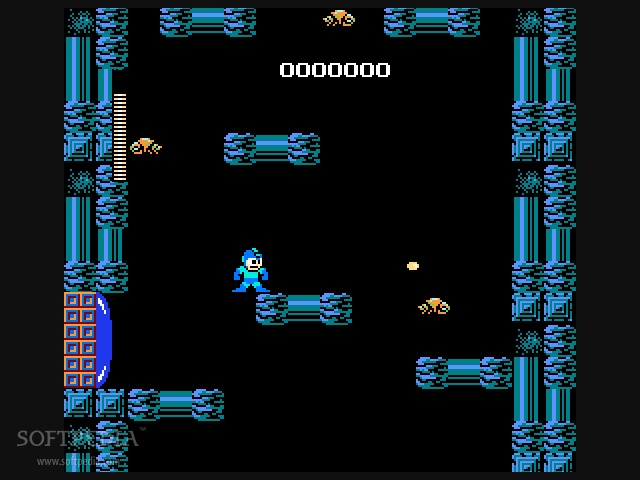
Though the environment tiles are highly detailed, the backgrounds are just flat black due to the NES's shortcomings and the already unstable framerate.
To understand just what is flawed about Metroid and why it is flawed, we need to look at a game with similar problems: Castlevania II: Simon's Quest. The first issue is that of control or lack thereof. Under normal circumstances, there is nothing wrong with Samus Aran's run, jump, or shoot. The controls are loose and maybe a little slow but nothing that can't be learned in time. It is the interruption of these controls that cannot be excused. Each time an enemy hits Samus, she is knocked back several tiles and player control is briefly revoked. Due to this, the player will often find themselves hitting other enemies or falling into deadly pits. The high number of enemies at any moment, which slows the game's framerate down considerably, also does not help this issue. Due to the extremely limited range of your shots, and the fact that most enemies take at least four hits to kill, getting hit by enemies and thus knocked back is almost inevitable. By 1987, in Castlevania II, players were already complaining about knockback from hits and so, as a general rule of game design, knockback in extreme forms was discouraged. One need not look further than the original Mega Man for proof that knockback did not have to be as extreme as the forms seen in Metroid or Castlevania and that it could still be an effective deterrence from running into enemies.

Swear to God, this just came up coincidentally when I searched for "Metroid Screenshot."
The pits are another matter entirely, as they hinder the player's ability to jump. In most games, you fall into a pit and you die. In Metroid, if you fall into a pit you are tortured, quickly losing health over time until you either die or escape. With enemies dive-bombing you the whole time, pits become frantic moments of frustration with the player unable to jump or shoot effectively, at least until you've found bombs which allow you to hit enemies in the air and bounce on the explosions.

Finding these things is almost like cheating.
My biggest issue with the game, though, is the lack of feedback. Items you find are complete mysteries until you discover their use for yourself as there are no tooltips or demonstrations. Missile doors don't open unless you shoot them with five missiles, and yet there is no sense that your shots are having any effect on them at first. There is no map of the world and so it is incredibly easy to get lost or have the sense that you are on a wild goose chase for items that may or may not exist, the purposes of which are uncertain. Hidden passageways containing important items, like under a normally torturous lava pit, also do nothing but confuse the player without proper visual feedback to the change in rules.

In Metroid, finding something rewards you with a tune. You are never shown what your reward is until you figure it out for yourself.
Several of these problems were eliminated in future iterations of the Metroid series. In Metroid II on Gameboy, Samus's shots traveled the full distance across the screen, making enemies easier to hit. Super Metroid was much faster; had greatly reduced knockback; unlike the original Metroid on NES, enemies did not take four or five hits to kill but just one or two, keeping the pace of the game fast and tight; and save states, as opposed to Metroid's 24 character password system, were a very welcome change. It is good then that Nintendo learned what they needed to for future iterations, and learned it quickly. Metroid is a prime example of how fickle game design is as a philosophy, and how in just a few short years a game can go from being a masterpiece to a goulash of mechanical missteps.

Thursday, June 7, 2012

Consoles are no longer Consoles


People these days talk a lot about how the next console generation will be the last console generation. They are wrong. The era of the XBox, PS2, and Gamecube was the last console generation. What we have now are not consoles. They are entire home entertainment systems contained in a small chassis. Other than the ability to receive phone calls, your smartphone and your entertainment chassis are pretty much the same thing. Everyone wonders when the next "console" generation will come out, and many were disappointed about the lack of announcements at this year's E3. Well, I hate to tell you, but it won't be for a while. Why? Contracts.


Let me break it down for you. Sony and Microsoft have contracts with many different companies to deliver media on their systems for a price. XBox alone has Netflix, ESPN, Hulu Plus, Amazon Video, DVR capabilities for Verizon and Comcast, and contracts with dozens of different production companies to stream and sell movies and music via their Zune service. With a new console, they would have to double up these contracts to get the same services on next generation hardware. Furthermore, the price of these contracts would go up. A more expensive console means the service providers would want a bigger piece of the pie. The apps for delivering all this content would have to be rewritten to be compatible with next generation hardware. The cost of a new entertainment chassis would be at least $699, or the price of a cheap computer.

It seems, though, that Microsoft may have a leg up on the competition in the form of Windows 8. Windows 8 was only briefly mentioned at their E3 press conference, and what was mentioned was the fact that XBox 360 games will be playable in the operating system. Also remember that Kinect is now compatible with Windows and Windows 8 uses the Metro UI, the same UI found on XBox 360 and Windows Phone 7. What this says to me is that the next XBox will be a Windows 8 computer, one with an app store where Microsoft can let these companies program their own executables. Unfortunately there will be no way to guarantee all the services at launch of the new XBox that are available as apps on the 360, but if it does just ship with Windows 8 then all those services will be accessible via their websites anyway.


One other bullet Microsoft will have to bite with a Windows 8-powered next gen XBox is that the platform will have to be more open. They can do their best to close it off, eliminating access to the registry, command prompt, control panel, etc. but they won't be able to do anything to stop developers from distributing apps over their own websites, or competing services like Steam. The only way they could would be if it did not have Internet Explorer installed from the start (which it will, what with it coming out on 360 this fall) or blocked installation of programs without some kind of digital approval stamp, much like what Apple is doing for OSX programs now. No matter how closed they try to make it, at its core it will be Windows 8-powered, and someone will find a way to gain access to the full Windows buried deep inside. At that point, there'll be no stopping it from becoming the rumored Steam Box.


So where does this leave Sony? Well, pretty much in the dust, unless they team up with Microsoft to create a Playstation-certified Windows 8 VAIO which, believe it or not, is a definite possibility. Heck, we've heard rumors that the next XBox will have a Blu-Ray drive. Since 360 games will be playable in Windows 8, they'll just all become PC games. That would just leave new, specialty Blu-Ray games to be playable in the system's drive, ones that would only be compatible with this system. Yes, I understand there is a lot of conflict here, mainly between Playstation Network and Xbox Live, but are either of those going to matter when you have Steam games running on your 60" TV? Don't think so.

In the end, the PC is going to be the winner, just as it has been for every console generation. At the beginning of a console generation, everyone thinks the PC is dead. By the end, PC game sales have embarrassed console game sales (cough Diablo 3 cough); they end up with more services, openness, usability, and power; no contract requirements on the end of the manufacturer; and PCs do not become outdated as quickly as consoles (with the exception of laptops built to be weak like netbooks).

Windows has won the console war. Deal with it.


Oh, right, Nintendo. Yeah, um, whatever.

Thursday, May 24, 2012

Thank God I Make Crap (And So Can You)

Today marked the end of 38 Studios and the second end of Big Huge Games, whom 38 Studios bought a couple years ago when they were going under. It's been a tumultuous week for Curt Schilling's company, with the news that they couldn't pay back their $75million loan from the state of Rhode Island, and now every employee getting pink slips. Sometimes business management is so bad it's inexcusable.
Cough
Which brings me to why I'm here. I mean, I'm in the same boat right? I run a company that makes games. Am I going to completely fuck over the hundreds of people I work with too?

The answer is NO and here's why. First, I work with about four people. We're small, close knit, and we're doing this out of love for the game we're making, not out of a desire to enter a market we know nothing about. Second, when we started out, we'd already made games and we found other people who'd made games to help us and determine the creative direction of the project, not just writers and comic book artists (protip). Finally, I'm not that guy. I keep my budgets at small as possible for a reason. I haven't had that many people play my games, Children of Liberty's Kickstarter wasn't anything to brag about, and its current alpha funding isn't doing so hot either (though it's on sale, 50% off for #becauseWeCan week). For this reason I keep my expectations on Earth.

Furthermore, when I started out, I didn't dive into the deep end of the pool without knowing how to swim. The MMO market is dangerous, and has been since 38 was founded. At any given point, there are about three subscription-based MMO's that make money: World of Warcraft, EVE Online, and a "MMO of the Month" (Age of Conan, Rift, Star Wars: Old Republic, take your pick). I started out with really small games, ones that hardly anyone has played. But you know what? I am fine with that. I am also fine with the fact that I have 4 or 5 gigs worth of unused prototypes. Like I was telling a friend of mine, I consider it my sketchbook. The only way to get good at any kind of artform is to keep making the art. 38 launched one game, which was already in development at Big Huge. Schilling bit off more than he could chew and the taxpayers of Rhode Island are going to have to eat the rest of it.

Don't let this discourage you from going into game development, even if you have no previous experience. Just don't have newbie ambition. If you're starting a company, you don't need to make an MMO. You can be as indie as you want, have a small team, and still make awesome games. The tools are available, even if you're poor. Or, if you're rich and want to get into game development, why not help fund some indie studios that can show you the ropes of development in return?

Saturday, May 19, 2012

David Perry Challenge #002 - Dr. Mario

Dr. Mario is a puzzle game created by Nintendo in 1990. The game has you lining up pills of 3 different shades to clear viruses on the puzzle board. It's a very simple premise that ramps up the difficulty as the game goes on. Few puzzle games manage to create a perfectly straight difficulty curve as the game goes on. Dr. Mario does.


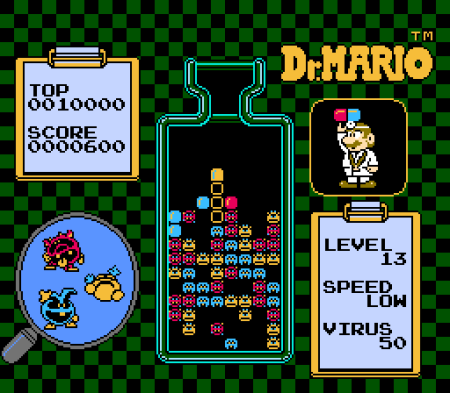
The primary resource in the game is the pills which Mario throws onto the board. Each pill has two halves, and each half is black, gray, or white. On the NES the colors are Red, Blue, and Yellow, probably one of the earliest examples of colorblind-friendly gameplay. This means each pill can be one or two colors, with six total variations. The game avoids falling into the tropes of Tetris or Match-3 by adjusting how the game is scored. Instead of awarding the player for just making matches with pills, players are only rewarded for making matches of four or greater that include the viruses scattered throughout the board, each of which is also black, gray, or white and the size of half a pill. When all viruses on the board have been cleared, the levels progress, and four more viruses are added to the board. While this does double the number of viruses on the board from the first level to the second, after that it actually becomes a smaller percentage increase per level (50%, 25%, 12.5%, etc.). This may seem like diminishing returns on the difficulty, but it gives the game value for your time spent playing and the board does start filling up pretty quickly. It allows the game to be elongated while never feeling like the player's time is just being milked.


The original Dr. Mario on NES is an early example of colorblind friendly gameplay.


To mix things up, there are also three speeds at which you can play the game (Slow, Medium, and Fast), two different songs to listen to while playing, and you can start at any level, from 0-12. However, starting at a higher level will not give you a higher score by default, so the challenge becomes a matter of survival instead of high score. Starting at a higher level is a great way to train for marathon sessions of the game, to help you get used to the higher pressure of a board that is nearly completely filled with viruses.
What makes Dr. Mario so much fun is its simplicity. All of its systems are on the surface, clear as day to the player. There is no back-end trickery, no subtle balance adjustments if you're doing too well (or too poorly), and no random powerups that throw the game for a loop. It's an old enough game too that your high score isn't even saved (on the Game Boy at least), so it's up to you to want to improve, not an online leaderboard laughing at your pathetic attempts to reach the Top 10.


In case you thought I only emulated it, here's proof of having the real thing!
There have in fact been many Dr. Mario games released, the most recent of which being Dr. Mario Express on the DSi. Yet, none of the future Dr. Mario titles have messed with the formula. Why fix what ain't broke? There have been some minor tweaks, though. For example, in the original Dr. Mario you would only see the next pill before it came onto the board. In the DSi and Wii versions, you see the next three. Dr. Mario on the Wii also had online play, a welcome (and rare) addition for any Nintendo game.
Dr. Mario on Wii features competitive online play for the first time in Dr. Mario's history.
Nowadays, with the introduction of microtransactions and online-gated gameplay (i.e. blocking out the player from enjoying the game if they are not connected to the internet for purposes of preventing piracy), I fear that a lot of the magic of Dr. Mario could be easily lost. Imagine if you dropped a dollar on the game and all of a sudden your next ten pills were “wild cards” that would make matches no matter where they went. Where would the challenge be in that? What about the fun? What I love so much about Dr. Mario is that it reminds me of a time when games were games, when developers weren't afraid to teach you all there is to know about a game in the first 30 seconds and that little bit created an infinite amount of replayability. If developers nowadays care about the gameplay, and not just about milking their players for all their money, they should take a serious look at Dr. Mario and revel in its simplicity. They should take note of how the formula for the gameplay hasn't changed in over twenty years, and yet it and its followups are amazing. That is truly saying something, and Dr. Mario is a truly great game.

Tuesday, May 8, 2012

David Perry Challenge #001 - Mirror's Edge

Today I bring you the first of the 100 game challenge, Mirror's Edge from Digital Illusions Creative Entertainment and published by EA in 2009. Video footage comes first and my 1-page writeup follows. This will be the format I follow every week.

Week 1: Mirror's Edge (DICE/EA, 2009)


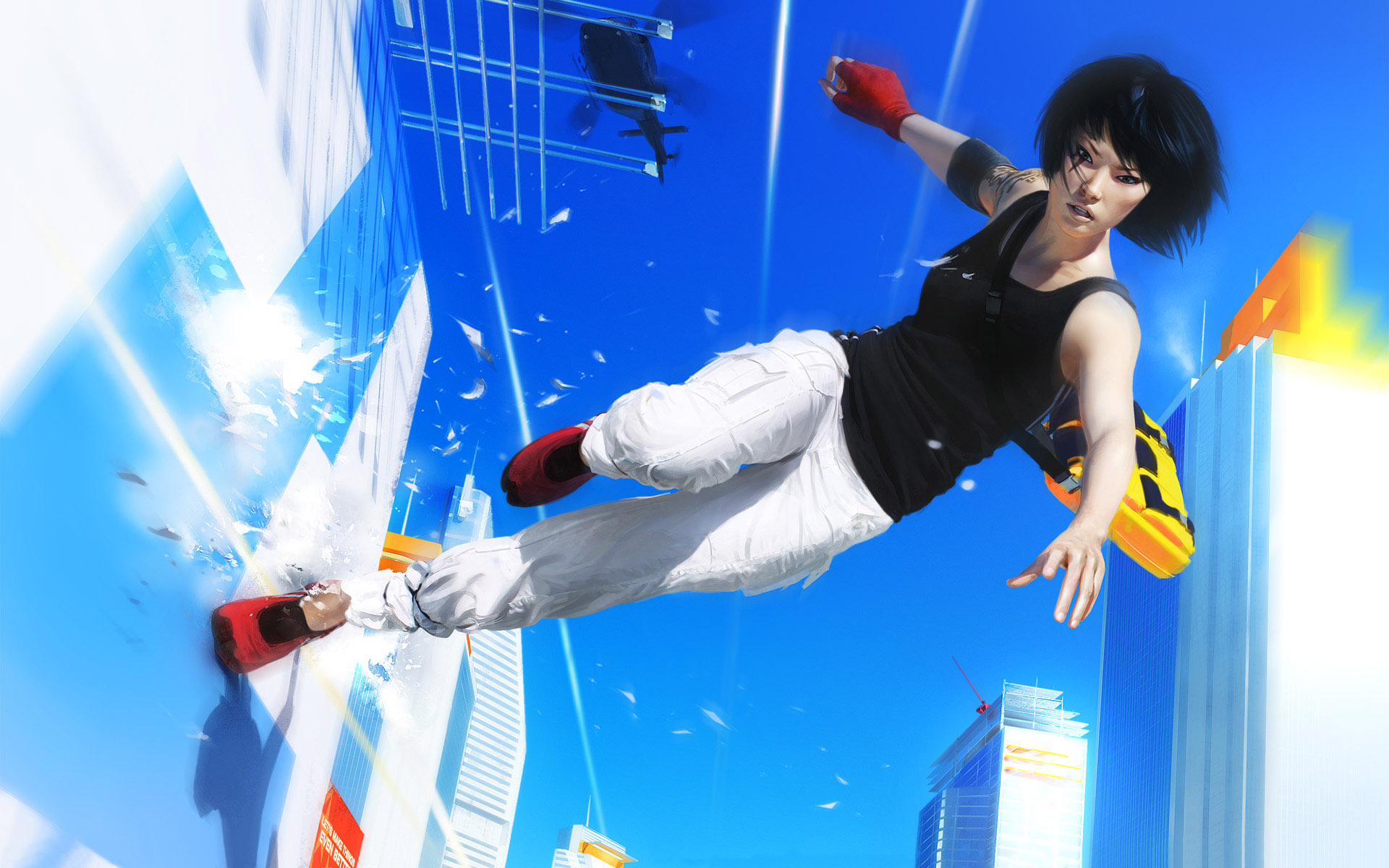
Mirror's Edge is a first-person free runner designed with the intent to create a high stakes experience in an adrenaline-pumping setting. The use of high-contrast colorization - which itself contrasts many of the releases of the current generation's use of brown, dull materials – creates easily navigable pathways with the use of red-shaded objects to guide the player's eye. Combined with the design choice to have bullets unable to hit you when you are going over a certain speed, Mirror's Edge is tediously calculated simulation of a game. It's smoke and mirrors, a highly glossy prototype, but nothing more.

This is not to say that it's a bad prototype. Quite the contrary, Mirror's Edge successfully posits the thesis that a game which takes place from a First-Person view can be used for more than just shooting guns. The parkour mechanics go beyond the basics of running and jumping to include two different kinds of shimmies, wall-runs, 180 degree kick spins, zip-lining, and vertical climbing. The visuals are incredibly striking, with the outdoor having a strong emphasis on blues and indoors favoring greens. In order to finish the RGB trifecta, Reds are used sparingly in order to guide the player toward what they need to grab onto or run at next. It's a simple technique that eliminates some confusion in an otherwise highly detailed and sometimes confusing world.

However, the game is not without its faults. While the parkour mechanics are solid for the most part, a lot of it feels like a pixel-hunt. It is easy to gloss over your goal half the time or miss a jump because your “Death Dot” cursor happened to be off from where you were supposed to have it. While a “Death Dot” in many games can be a blessing of precision-based shooting, here it only serves to hamper the experience. The purpose of free running is just that - to be free in your running – and yet more than once I found myself unable to get through a section the way I wanted to. Even though it looked like a wall would be ideal for wall-running, or the gap between platforms easily jumped over, the section was specifically designed for you to shimmy across the ledge on the side. It is moments like this that force the realization that the player is being led; that any sense of agency they have in the game world is an illusion, and the whole game has been laid out to be played in a specific manner. Do it any other way and you will not only die but will have to replay the current section countless times before you are allowed to continue.

While Mirror's Edge makes itself out to be an open world, it only leads the player down a linear path. It's possible that this “illusion of freedom” motif mirrors, as it were, the game's totalitarian narrative. Any freedom one is led to believe they have is actually a carefully constructed ride, with ups and downs, glimpses of choice, and much like the game's high contrast aesthetics, shimmers of greatness. The game's challenge come from finding the path through levels laid out by the designers, not by creating your own as the game would have you hope would happen. The skill comes in the form of precisely timing and aiming your jumps (a slow-motion mechanic is included to assist in this endeavor and disarming enemies, though it almost seems as if it too was at one point included in the ride and was changed to a button-press at the last minute). While you can take enemies guns and shoot them, the game in no way encourages this behavior. Gunplay is a sloppy, slow, throwaway mechanic. Being that this is from the studio that brought us Battlefield, we know damn well that they are capable of forging solid first-person shooter mechanics. The gunplay is all part of the simulation. The player is given the illusion they can use guns, but that use comes at the cost of usability. In the end, it is a better choice to just throw the guns away. Even the bullets flying at you are all part of the ride and are themselves an illusory threat. There are a few tense moments to be found here, but once you realize just how shallow the rabbit hole actually is, the tension wears off quick.

There are some good ideas in Mirror's Edge, but they are all at odds with each other. The mechanics are shoehorned into an expressionistic use of narrative-as-gameplay, yet the gameplay itself can do nothing to alleviate the feeling that the roller-coaster is too well constructed. We are still safe.

Friday, May 4, 2012

Game Challenge - An Introduction

I have started a new channel on Youtube called "Don't Start" to hold all the videos for the David Perry Challenge. I have also posted the first video, outlining my goals for the challenge.


As it stands, I will playing games on the following systems:

  • PC: 20 games
  • XBox 360: 20 games
  • PS2: 20 games
  • NES: 10 games
  • SNES: 10 games
  • Gameboy: 10 games
  • HP Touchpad: 10 games
I already have the list of games I want to play set, though I will not be revealing this list beforehand in case of any of it has to change for whatever reason.

Now, the tricky part. I am poor. Quite poor. Sentence fragment. In fact, I straight up can not afford to do this challenge, and I want to do it right. As I work in the game industry, I have not ever nor will I ever pirate games (Abandonware is another matter altogether, and I love Abandonia.com). I am wondering, since this is basically a combination of a thesis and a bit of a creative endeavor with the Youtube channel, if a Kickstarter would be a smart way to go to help me do this challenge right (I would need probably close to $1500, more if I expand the channel to include other kinds of videos). My other alternative would be to source games from the community and my friends, to see if anyone would be willing to let me have some of their old cartridges. However, I do have games in the list that are a download-only affair (like the ones for the Touchpad) so those will still eat into my available funds. Thankfully I have two years to get this all done, so hopefully by that point Children of Liberty will have sold a few more copies (won't you please help a starving indie out?).

I'd like to do some other stuff with this channel too. Podcasts, Let's Plays, News, maybe even bring in some other content creators so I still have time to work on Children of Liberty. Additional content depends on if other people want to contribute videos and if my development time permits me to be doing anything else. If this starts interfering with my development time I will have to put the challenge on hold, but with my current goals I should be able to do it.

Please make sure to Subscribe to the new channel as the first of my 100 games will be up some time next week(ish), and one a week from that point on!